A critical control point (CCP) is a step in your process at which a control measure is essential to control a significant food safety hazard. You give it a critical limit, often a temperature and a time, that separates acceptable food from unacceptable food. In the European Union, every food business operator working after primary production must apply procedures based on the HACCP principles, which include identifying these points.
What is a CCP?
The Codex Alimentarius General Principles of Food Hygiene (CXC 1-1969, revised in 2022) define a CCP as ‘a step at which a control measure or control measures, essential to control a significant hazard, is/are applied in a HACCP system’. French texts use two names for it, which mean the same thing; in English, the Codex and Regulation (EC) No 852/2004 both say ‘critical control point’.
Article 5 of that Regulation requires operators to put in place, implement and maintain a permanent procedure or procedures based on the HACCP principles. You review these procedures whenever the product, the process or any step is modified. The Codex sets out seven principles, and determining the CCPs is the second:
- Conduct a hazard analysis and identify control measures.
- Determine the CCPs.
- Establish validated critical limits.
- Establish a monitoring system for each CCP.
- Establish corrective actions.
- Validate the HACCP plan and establish verification procedures.
- Establish documentation and record keeping.
The same hazard may need more than one CCP. The Codex gives this example: the cook step may be the CCP for killing the vegetative cells of a pathogenic spore-former, and the cooling step a CCP to prevent germination and growth of its spores.
Rules checked in November 2026.
How does a CCP differ from GHPs and an OPRP?
Good hygiene practices (GHPs) are the fundamental measures, applied at any step within the food chain. Together with other prerequisite programmes, such as training, they set the foundation for a HACCP system. The Codex recognises that some GHPs have a greater impact on food safety than others and may need greater attention: it cites the cleaning of surfaces that come into contact with ready-to-eat food. A CCP goes further: it has its own critical limit and its own monitoring.
You will also come across the operational prerequisite programme (OPRP), which French texts call the PRPo. For Walter Learning, a French training provider, the OPRP is a programme in its own right, and the critical limit applies only to the CCP.
What are some examples of CCPs and critical limits?
You decide your CCPs from your hazard analysis, and there is no universal list. The thresholds below come from regulations and official guidance. They give you a starting point when your analysis identifies the step as a CCP, and you then validate your critical limit, as the third principle requires.
| Step | Threshold | Where, and under which text |
|---|---|---|
| Cooking | Core temperature of 70 °C for 2 minutes, or 75 °C for 30 seconds | United Kingdom, government guidance |
| Rapid cooling | No more than 2 hours at the core between +63 °C and +10 °C, then storage between 0 °C and +3 °C | France, institutional catering, French order (arrêté) of 21 December 2009, Annex IV |
| Rapid cooling | From 60 °C to 10 °C within 2 hours at most | Belgium, retail, including institutional kitchens, caterers and restaurants, royal decree of 13 July 2014 (in French), Article 23 |
| Reheating | No more than 1 hour between +10 °C and the serving temperature, itself at least +63 °C | France, institutional catering, same order, Annex IV |
| Dishes delivered hot | +63 °C minimum | France, same order, Annex I |
| Dishes kept hot | 60 °C minimum | Belgium, retail, same royal decree, Article 23 |
| Dishes kept hot | At or above 63 °C if you are not serving them straight away; you can keep them below 63 °C for up to 2 hours | United Kingdom, same guidance |
| Chilled storage | +3 °C maximum for dishes prepared in advance | France, same order, Annex I |
| Chilled storage | 8 °C or below | England, Wales and Northern Ireland, same guidance |
| Quick-frozen food | −18 °C or lower at all points in the product, with brief upward fluctuations of no more than 3 °C during transport | European Union, Directive 89/108/EEC, Article 5 |
The French order allows slower cooling or a lower serving temperature if a validated hazard analysis proves that these values remain safe. In Belgium, the G-044 self-checking manual (in French) from the Belgian food safety agency (AFSCA/FAVV), written for the B2C sector, classes the cooling of hot food to be kept chilled as a CCP of its simplified HACCP system.
Rules checked in November 2026.
Can transport be a CCP?
Yes, if your hazard analysis identifies it as one. Transport temperature already falls under your GHPs, since Regulation (EC) No 852/2004 covers it in Annex II. Where necessary, your conveyances and containers must be capable of maintaining foodstuffs at appropriate temperatures and allow those temperatures to be monitored (Chapter IV, point 7). The cold chain is not to be interrupted, except for limited periods of handling that do not result in a risk to health (Chapter IX, point 5). In Belgium, the G-044 manual treats the temperature of food on receipt as a CCP of the simplified HACCP system.
Your critical limit is then the temperature of the product, and your monitoring is the reading of that temperature. When a carrier handles this journey, you check that its temperature range meets your critical limit.
Rules checked in November 2026.
At Shippr, refrigerated transport runs in a refrigerated vehicle reserved for your goods and set to their temperature range: chilled (0–4 °C, or 0–7 °C depending on the products) or frozen (−20 °C for quick-frozen products). We bring the vehicle to temperature before loading. On your regular multi-drop rounds, a logger records the temperature continuously and we alert you to any deviation.
What is a critical limit?
The Codex defines a critical limit as a criterion, observable or measurable, that separates acceptability from unacceptability of the food. When you fail to meet this limit, the Codex calls it a deviation. You then apply the corrective action your plan provides, for example isolating the batch concerned and deciding what happens to it.
You monitor each CCP so that you see this deviation in time: you decide who measures, how often and where you record the result.
Rules checked in November 2026.
How do you determine a CCP?
The Codex describes applying the HACCP method in 12 steps, and determining the CCPs is the seventh. It follows the hazard analysis, in which you identify, for each step, the significant hazards and their control measures.
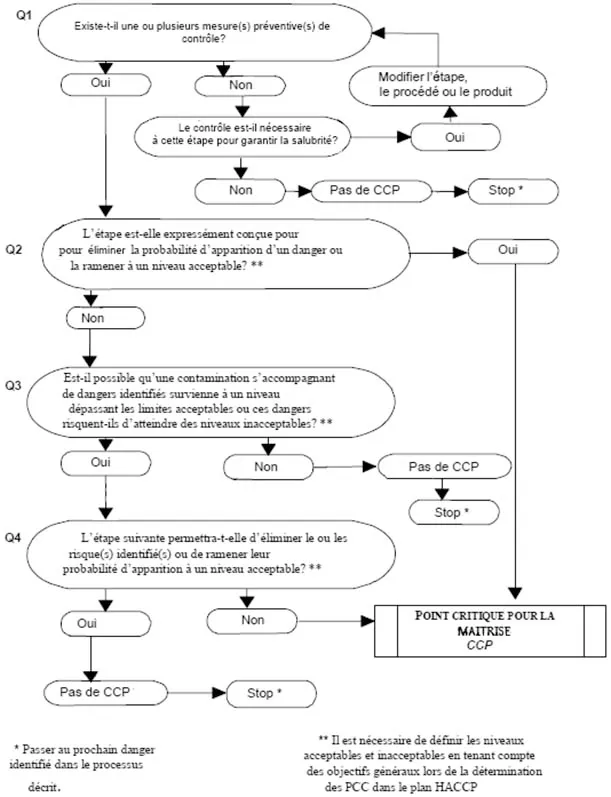
A decision tree then helps you decide, hazard by hazard. It is not an obligation: the Codex presents it as an example, and you can use another tool or consult an expert. The one published by the Canadian Food Inspection Agency, developed by Codex, asks four questions, to be followed in order:
- Do preventive control measures exist for this hazard?
- Is the step specifically designed to eliminate this hazard or reduce its likely occurrence to an acceptable level? This question applies only to processing steps, not to incoming raw materials.
- Could contamination occur in excess of acceptable levels, or could the hazard increase to an unacceptable level?
- Will a subsequent step eliminate this hazard or reduce it to an acceptable level? If your answer is no, the step is a CCP for that hazard.
The chart below gives every exit, question by question. It is in French; the Canadian agency’s page has the English one.
Which guides help you set your CCPs?
Regulation (EC) No 852/2004 asks Member States to encourage national guides to good practice for hygiene and for the application of HACCP principles, which food businesses may use on a voluntary basis. Depending on the country:
- In France, good hygiene practice guides (GBPH) are validated by the government (in French), under a protocol between three government directorates: the DGAL (food), the DGCCRF (competition and consumer affairs) and the DGS (health). Scientific evaluation by Anses, the French food safety agency, is an optional step. These guides let professionals, particularly SMEs, pool the first steps of the HACCP approach.
- In Belgium, every operator in the food chain must have a self-checking system (in French) that contains GHPs and is based on the HACCP principles. The basic text is the royal decree of 14 November 2003 (in French). Sector organisations write the self-checking guides and AFSCA approves them.
- In the United Kingdom, your business’s food safety management system must meet the HACCP principles. Small catering businesses can rely on Safer Food, Better Business, or on Safe Catering in Northern Ireland. In Scotland, catering businesses have CookSafe.
Rules checked in November 2026.
To build your plan step by step, download our HACCP guide, with advice and worked examples.
CCPs are part of the HACCP plan. Find out about its other steps in our article on the HACCP method: definition, principles, rules and training.